
Q&A: Nikkolas Smith
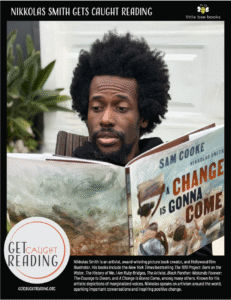
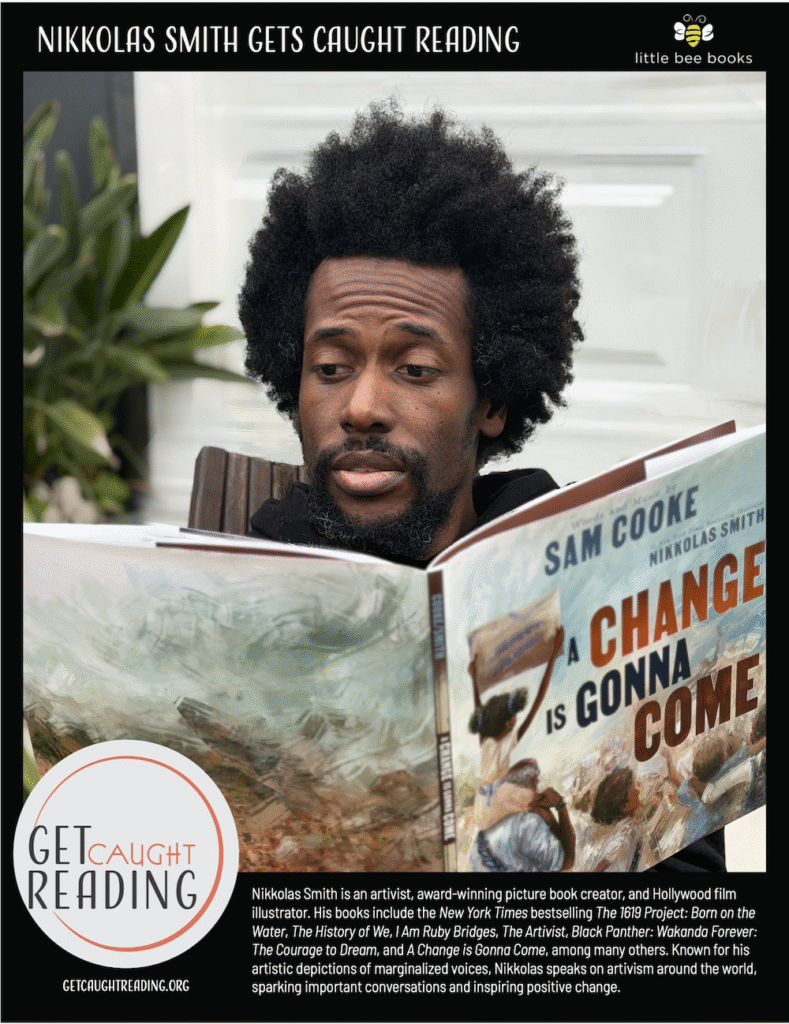
The CBC talks with Nikkolas Smith, artivist, award-winning picture book creator, and Hollywood film illustrator. Nikkolas is also in one of our latest Get Caught Reading posters.
Both A Change Is Gonna Come and The History of We engage deeply with history and collective memory. What drew you to these projects at this point in your career?
Both of these books tie back to childhood memories, growing up hearing from my parents about how we all come from Africa (The History of We) and also hearing Sam Cooke’s A Change is Gonna Come in Spike Lee’s film Malcolm X, and throughout my life. For The History of We, I’ve always wanted to explore the paleontological details connected to the dawn of human history, and for A Change is Gonna Come, it was a dream to be contacted by Little Bee Books with the opportunity to illustrate Sam Cooke’s civil rights era classic.
How did your illustration process differ between A Change Is Gonna Come and The History of We, if at all?
For A Change is Gonna Come, I stayed with my most recognized form of picture book illustration, which is digital painting in Photoshop on my Wacom Intros Pro. For The History of We, I decided to go back to the basics as it relates to the first creators in human history, and hand-paint the book on stretched canvas, which was my first time using this method for a picture book.
How have these two books shaped or stretched you as an artist?
For A Change is Gonna Come, I had to dig deep into Civil Rights era historical moments to be able to somewhat grasp the grief in the resistance and protest of the time, but also to pull out their vision for what hope and change truly looked like for them, and us today. For The History of We, studying the Middle Paleolithic Era in depth, and finding the fossil and migration research allowed me to become a bit of an anthropologist-artist, which I never thought I would become, but it helped me to present the book as a nonfiction, National Geographic-style documentary in picture book form.
In what ways do you see children’s book illustration as a form of activism??
I model my artivism after Nina Simone’s quote that says “it’s an artist’s duty to reflect the times”, so it’s an honor to be able to create picture books that reflect American history and Human history as it actually happened, and allow people of all ages to draw inspiration that can empower us to move our society in a positive direction.
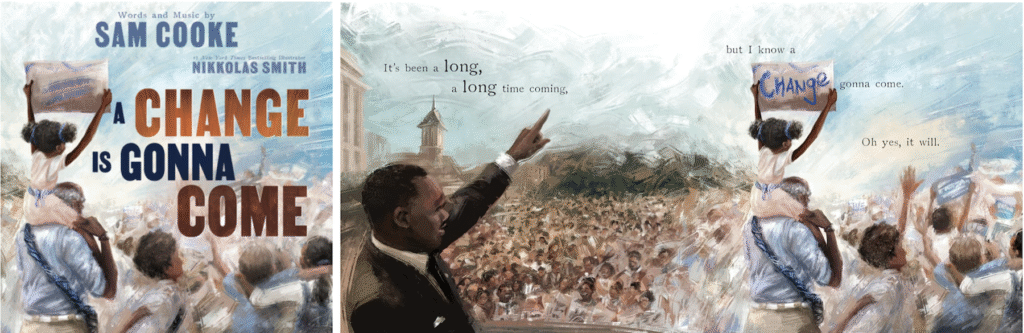
A Change Is Gonna Come carries a powerful emotional and cultural legacy. How did you approach illustrating a story that already resonates so deeply with multiple generations?
I loved the idea of visualizing this boy that was “borrrn by the river”♪ ♫ but also to have him discovering a Voigtlander Brillant camera in that water, which he could use to document the highs and lows of the Civil Rights era. When I’m speaking to students about my picture book The Artivist, I remind them that photographers are also artists, and can be great Artivists when using that creative outlet to document various struggles that are resisting oppression.
What role does movement—marching, gathering, reaching—play in the visual narrative of A Change Is Gonna Come?
I love showing movement and movements in my artwork. This book allowed for many opportunities to show crowds or individual people putting their bodies on the front lines for justice, holding signs, facing racist opposition, and making their voices heard. It’s an extremely important visual to remind a new generation of the cost of justice and freedom.
Was there a particular historical moment or contemporary image that influenced your illustrations for this book?
The real-life events portrayed in the film “One Night In Miami” were very important to me to portray in this book, partially because Gordon Parks was so closely connected to Ali, Malcolm X, and the others. I wanted to recreate that moment of Ali and Malcolm at the bar, and also tie in Ali’s short but powerful poem: “Me…. WE.”
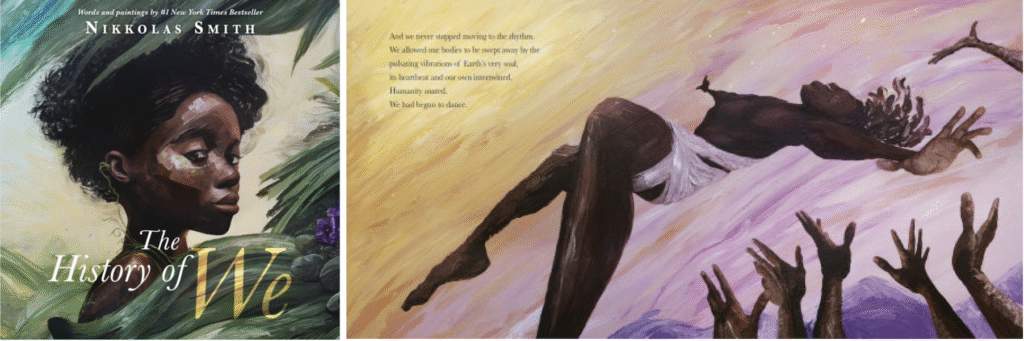
The History of We centers on collective identity. How did you visually represent the idea of “we” rather than focusing on a single hero?
I decided to span multiple African cultures and eras, from 233K years ago to 95K years ago, and highlight many innovative achievements, so the book captures a collective identity in that sense, and then pushes into the global diaspora from 95K years ago to now.
What choices did you make to ensure children from many backgrounds could see themselves reflected in the illustrations?
This book culminates with my “Became We” poem, and was a great opportunity to visually represent all the numerous cultures, skin tones, and facial features that were born from the millennia following the first traveling tribes leaving Africa and populating the world. It’s a reminder that we are all connected, and are literally all one human race.
How does this book invite readers to see themselves as part of history—not just observers of it?
From the moment you see MAWA or “Queen Mother” on the cover of The History of We, it’s a reminder that every person on Earth can be traced back to her, in Omo Kibish, Ethiopia. It’s reflecting a piece of everyone’s family tree, and a call to reach back far enough that all of our roots begin to tell the same story. But specifically for Black children, it is a reminder that the world’s first Artists, Astronomers, Swimmers, Explorers, Medicinal Healers, etc., looked just like you.
Thank you, Nikkolas Smith!
