
Mentor Corner: Karen Vermeulen

Illustrator and Cover designer, Catalyst Press.
What was your first job in publishing?
I illustrated my first picture book in my twenties (I’m 47 now), and it was sooooo bad! I teach illustration, and occasionally I show it to clients to prove that practice does improve your skills! I do that because people often tell me how ‘talented’ I am and how ‘untalented’ they are, and while talent is real and sure helps, it’s not enough; regardless of your level of talent, if you just keep going at it, you will get better.
What was your career path like getting to your current role?
I studied to be an art director, and my background is as an art director and designer in advertising. I’m a self-taught illustrator and always did it as a side hustle, and I always tried my best to work illustration into all my advertising jobs as much as possible. I’ve just always loved it. In 2010, I quit my last permanent job in advertising and started freelancing, and over time my illustration and book cover design jobs took over; nowadays I rarely do advertising agency work.
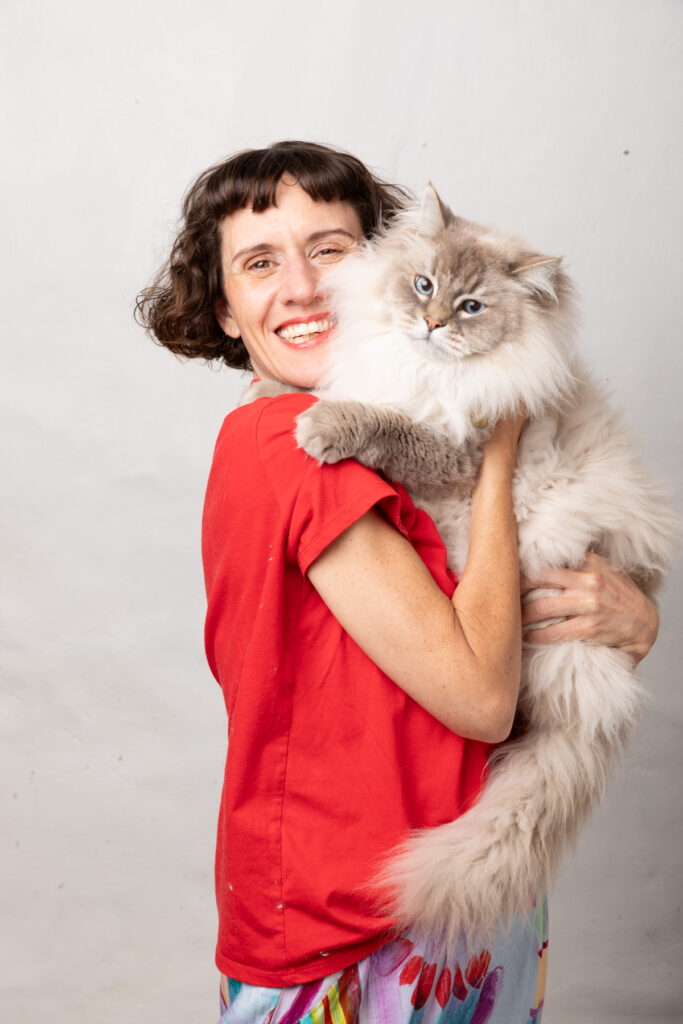
My work became mostly publishing-oriented in 2016 when I was introduced to Jessica from Catalyst Press through a colleague. Catalyst Press had just started, and I actually designed their logo; since then I’ve designed many book covers and illustrated many books for them, AND I designed, illustrated, and wrote my own book, Good Luck to Us All, a graphic memoir of sorts that was published by them last year!
What advice would you give to those who are either just starting out or are in their first few years in publishing?
As a creative, you need to have the mindset of an eternal student; you need to always be learning and improving, and you need to stay on top of new programmes, trends, things like AI, and just in general what is happening in the world and in our industry. Be curious, open-minded, and willing to learn.
The other thing that I would suggest is to get a full-time, on-site job as a creative. I learned so much AFTER college by working in agencies and studios. Even though it wasn’t publishing, all those skills were transferable. And it’s not just about working with more experienced creatives and seeing what they do; it’s also about getting to know the DTP guy, the project manager and the account manager.
Don’t stay in that first job too long; learn what you can and move around. Every agency and studio is different, you learn different things and also what works and what doesn’t in terms of how places are run. Having that kind of well-rounded experience and understanding is invaluable. And as much as I love sitting on my couch with my cat and drawing on my iPad with no annoying colleagues around me, I’m so glad I got to experience so many different creative workplaces and people; that was far more valuable in terms of an education than college!
My last piece of advice is probably the most important. Going into the workplace now, you HAVE to consider the impact of AI on the present and the future. I see so many creatives being staunchly anti-AI, and happily proclaiming that they are proud to be “left behind” and refuse to engage with it, and I just think, OK, I hope you have a trust fund, wealthy partner/family, savings, retirement fund, etc. It’s so bad that I’m actually nervous to speak on it, because creatives are getting cancelled left, right, and centre if they even glance at ChatGPT.
Black-and-white thinking is a pet peeve of mine, and I find that nuance is often sorely lacking in society. I’m NOT ok with ‘creatives’ letting AI do all the work and proclaiming themselves as the creator of the work. I’m definitely not ok with copying someone else’s work with the help of AI, but I do think that if you are a genuine creative who has put the time and effort into honing your skills, there is a place for using AI as a tool, much like we use Photoshop or Procreate or any of the other myriad of tools we use. There is a way to do it ethically, and I think it’s important to be up to date with what is happening with AI and how it is affecting our industry and your future as a creative. It’s here, and it’s going to impact our industry more and more as it improves and gets widely adopted. Shaking your fist in the air and shouting about being proudly left behind isn’t going to change that.
We can’t stop this from happening, just like the Industrial Revolution couldn’t be stopped. It’s up to you to familiarise yourself with it and future-proof your career. Turning a blind eye is a luxury many of us can’t afford. It won’t take all the jobs, but it will take away a lot of the jobs it already has, and it will change the type of roles and jobs in our industry. So you always need to think about what you can do that AI can’t and what skills you need to learn to ensure that your career has longevity.
What are your current favorite reads?
I get asked this a lot, and it’s always funny and a bit embarrassing to me, because what I read is miles away from what I write and illustrate. You might not guess from looking at my memoir with my funny little cartoons or my children’s books with sweet faces and cute animals, but the genres that I mostly read are horror, thriller and mystery. I recently read Black Sheep by Rachel Harrison; the twist is so fun. I loved it. Very dark, but one of my favorite books is We Need to Talk About Kevin by Lionel Shriver; it’s just so well written and worth the second-hand trauma. Lastly, another stand-out for me is The Southern Book Club’s Guide to Slaying Vampires by Grady Hendrix, and I don’t even like anything vampire, but a friend bullied me into reading it, and I’m so glad she did! Same with We Need to Talk About Kevin; I normally avoid trauma-heavy reads like that, but for me it’s such a testament to how good the writing is if I end up loving a book I’d normally avoid. But if you are into lighter books, I suggest mine! Good Luck to Us All is light, funny and very different from what I consume!
How has the publishing industry changed since you started your career?
Not just in publishing, but in the creative industry as a whole, quality has just gone down the drain. When I was a little baby junior art director going into my creative director’s office with my stack of papers scribbled full of ideas and designs, he would shout at me before I even stepped foot in his office, “are those award-winning ideas?” The standards were high, and we all lived in fear of not being good enough. Nowadays, the stuff I see out in the world would’ve gotten me fired if I dared to bring it to a review!
I sound so old and grumpy, but these days everyone thinks they are a creative, even if they’ve never opened a PSD or even know what it is. (Back in my day) 😅 Canva was for the kids making cute social media posts; now it’s widely accepted as a legit design tool, and it’s completely normal and accepted to sell yourself as a professional designer even if that is all you know! All the bad writing, illustration, and design make my eye twitch. I think it’s because budgets have just gotten smaller and smaller through the years, and there are more easy and cheap online tools available, and at the end of the day the bottom line wins out over well-crafted work done by an experienced professional. Working through the night and being screamed at by my CD as a junior wasn’t great, but neither is what we currently have. But I suspect that the downward spiral of bad AI and cheap design will get so bad that the pendulum will swing the other way again, and people will be willing to pay more for craf. Hopefully we end up in some happy medium where creatives get paid fair rates, get treated well, and in return produce good quality work.
Check out more from the Early Career Committee on our blog.
