
Industry News
-

Getting It Right
Contributed to CBC Diversity by Peggy Kern
The first time I met Miracle (not her real name), she arrived in a full suit of armor: a thick mask of makeup, black eyeliner pointed like arrows at the edge of her eyes - a warning, perhaps, to not look at her the wrong way - hair slicked back into a severe ponytail, a jean skirt and flat black leather boots suitable for running away, if need be.
My friend, a detective with the NYPD at the time, had arranged the meeting. Miracle was known to police as a reliable source of information about sex traffickers in Brooklyn. She is also a survivor of child prostitution.
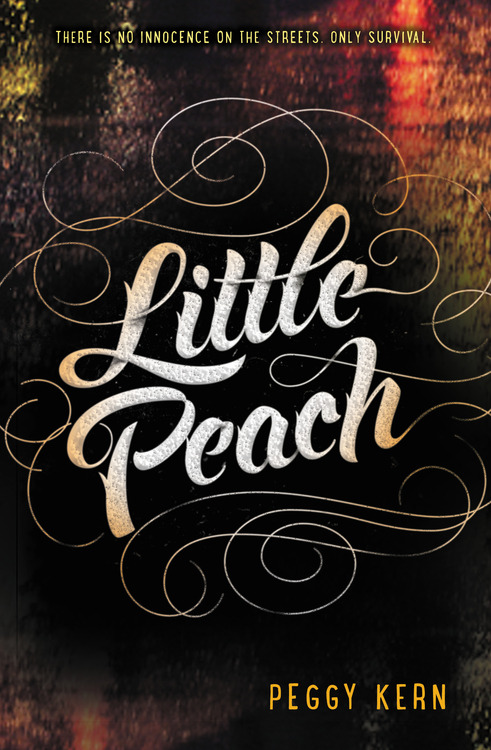
When I decided to write Little Peach, I knew I could not attempt the story without speaking directly with victims. I felt I had no right to type a single word on the page without doing so. Little Peach could not be my sheltered imagining of the issue, but an accurate account guided by the victims themselves. My job was to cede my voice, and give rise to theirs.
The first night we met, Miracle and I spoke for three hours.
She told me about the scouts that lie in wait at bus terminals and outside of group homes, looking for runaways and desperate, injured kids. She told me I could go to Port Authority that very night and I would see men wearing red or blue – signifying their particular gang affiliation – hunting for girls.
She showed me the tattoos she was given by her pimp, including a five-point red star placed strategically behind her ear by a sect of the Bloods that deals in trafficking. The placement is intentional: she could easily be identified as their property with the turn of her head.
She explained to me how traffickers use drugs to hook young girls. She herself was hooked on crack-cocaine by the age of twelve. She told me they target black and Latino runaways because, and I quote, “Somebody’s always lookin’ for the white girl, or she’ll want to go home. And that makes her a risk.”
She talked about her mom, who was a prostitute and addict, and the sexual abuses she endured at the hands of mother’s “customers.”
She taught me the difference between the young girls who are sold online and kept out of sight in hotels, and the older ones who are put out to pasture on the “track” – a term for the largely unpatrolled street corners where women are sold.
She told me about the girls she’s loved like sisters through the years. Some of them were murdered. Some were sold to other pimps. Most simply disappeared into the prison system or the streets.
She could not talk about her foster father, who had abused her so badly she still, all these years later, had no words to describe it.
She cried. So did I. And she said, “No one ever asked me these questions before.”
The second time we met, Miracle arrived in a comfy sweat suit. No makeup, hair down. Soft eyes. Sneakers. She continued to talk. And I listened to every word she said.
My time with Miracle, and with another woman named Jen, who I met on the “track” on Flatlands Avenue in Brooklyn and whose story was unbelievably similar to Miracle’s down to a tattoo on her chest, informed the voices of Michelle, Kat and Baby – not just culturally, racially, and socio-economically – but emotionally. There are moments in the book when Michelle can barely speak to you. Her sentences are broken. She almost loses her ability to communicate because what’s happening is so intolerable. It’s like she’s whispering, or turning her head away. That is the voice of Miracle, in many ways. And of Jen. And of the other girls I watched in the hotels of Brooklyn, but could not get near.
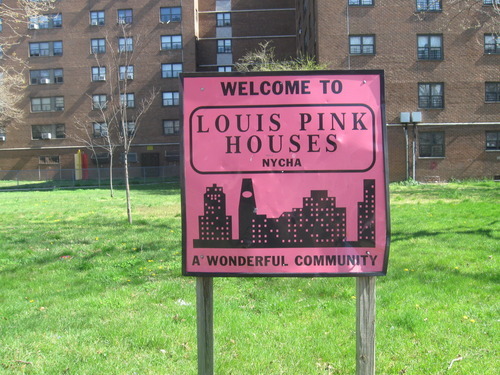
Miracle also taught me the geography of Little Peach. I depicted her world as best I could, and the world shown to me by my friend with the NYPD. Pink Houses, Coney Island (where Miracle and I would meet), even North Philadelphia, where I spent time working with students years ago – those locations are as real as the girls Peach represents.
Over and over, as I was writing the novel, I would ask myself: Would Miracle agree? Would Jen? If they read this, would they nod their heads and say, Yeah. That’s right, Peg. That’s how it went down.
Research is important, no matter what you’re writing about. But for Little Peach, it meant the difference between my sheltered imagining of what sex trafficking is like – and the actual accounts of victims.
The obvious truth is that no matter how much time I spent in Brooklyn, no matter how many conversations I had with survivors, I will always be a white woman. And I always got to return home to my apartment at the end of the night, where I sleep in safety, where I have food in my refrigerator and where my blond daughter lives in privilege compared to so many other girls in this country.
That I cannot change. And yet, the story matters so much. Peach matters so much. And so, you try. As a writer, as a human, you try – with all your powers and heart and inescapable limitations – to accurately depict the children you are bearing witness to.
You do your best to get it right. And if you missed the mark in moments, you own that, too.
But silence is not an option. Silence – when kids are literally dying – is unacceptable.

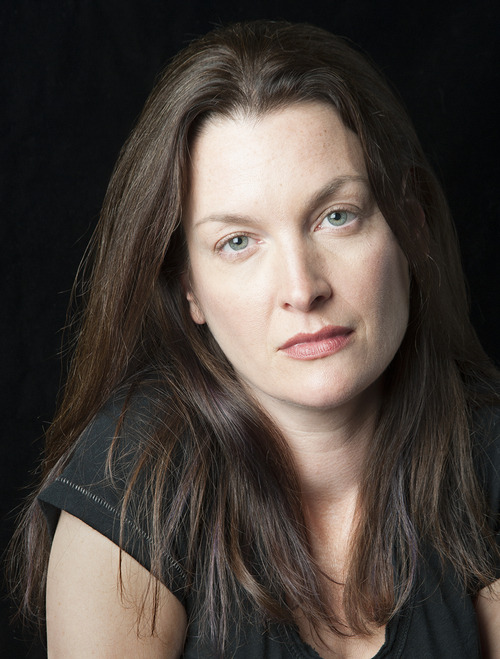
Peggy Kern has written two books for the Bluford series. She lives with her daughter in Massachusetts.
-

Audible to Produce Direct-to-Audiobook Stories
Fantasy writer Philip Pullman is one of many writers (from TV, film, and literature) to participate in the new audio storytelling project: I love this…We are taking part in a …
-

'Rosie Revere, Engineer' to Star in Story Time from Space
STFS was launched in 2011 by former Director of Education at Space Center Houston, Patricia Tribe, in the hopes of inspiring children’s love of literacy and STEM subjects (Science, Technology, Engineering, and Math). Beaty …
-

Possibility of Prequels in the Hunger Games Film Franchise
Francis Lawrence, the director behind three of the four Hunger Games movies, sat for an interview with MTV, and discussed the possibility of continuing with the highly successful franchise. Everybody is …
-

SCBWI Announces the Winners and Honorees of the 2015 Golden Kite Awards & Sid Fleischman Award
The Society of Children’s Book Writers and Illustrators is proud to announce the recipients of the 2015 Golden Kite Awards and Sid Fleischman Award. These awards, which are the only …
-

Authors & Books Announced For BEA's Editors' Buzz Forums
Norwalk, CT — BookExpo America (BEA) has revealed the authors and books that have been selected for this year’s Editors’ Buzz Forums. Three separate committees of booksellers, librarians and other industry professionals …
-

WNDBChat with African-American Authors
The authors answered questions on the topic of diversity in children’s literature, and shared their experience writing inclusive stories. A transcript of the chat can be found here.
-

Hollins University to Establish the Margaret Wise Brown Prize in Children's Literature
Children’s book publishers will submit their nominations for the award. From this pool, a panel of three judges (picture book authors themselves) will select a winner. Winners will receive a …
-

Ilyasah Shabazz Writes YA Novel Based on Father, Malcolm X
When you look at my father’s life, many people don’t realize you have a young man who the world learned of when he was only in his twenties. He was …
-

Michelle Hodkin Shares the Story of How She Became a Writer
Like every other novelist, my book was inspired by an idea. I’ve had lots of those, and it’s hard to articulate what it was about this one that held me …
-

Black Children’s Books for Better Bodies and Better Brains
Among the 16 titles are: My Friend Maya Loves to Dance by Cheryl Willis Hudson (Abrams) Jonathan and His Mommy by Irene Smalls (Little, Brown/Hachette) Kevin and His Dad by …
-

Nickelodeon Nominates 6 Middle-Grade & Young Adult Books For a Kids’ Choice Award
Nickelodeon’s Kids’ Choice Award “Favorite Book” Nominees The Diary of a Wimpy Kid series by Jeff Kinney The Divergent trilogy by Veronica Roth The Heroes of Olympus series by Rick …
-

Kate DiCamillo on the Power of Reading Aloud
DiCamillo’s PSA is a perfect reminder of two upcoming literacy celebrations,Read Across America Day, a program by the National Education Association held on March 2; and Drop Everything And Read on April …
-

Possessed by an Idea, Embraced by the Other
Contributed to CBC Diversity by Hester Bass
When I visit schools, it’s the question I am asked most often: where do you get your ideas? I jokingly answer “on sale at Target” before revealing the truth: ideas come from everywhere all the time.
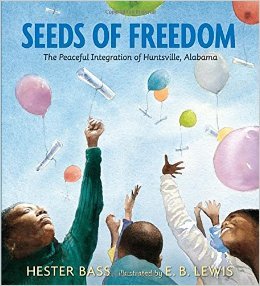
The idea for my book, Seeds of Freedom: The Peaceful Integration of Huntsville, Alabama (Candlewick Press, illustrated by E.B. Lewis) came from two historical markers I noticed in that city where I lived for ten years, noting that the first instance of both an integrated public school and a “reverse-integrated” private school occurred there during the same week in September 1963. I went straight to the public library, expecting to find a children’s book about these events, but none existed. It seemed the idea had chosen me.
I became committed to celebrating this peaceful chapter in civil rights history, spending six years researching in the library’s historical collections and interviewing local people. I was also transported to my own experiences as a first grader in 1962.
My memories of the Civil Rights Movement are those of a child in rural Georgia, mostly from a black-and-white television set. I remember it seemed strange that there was so much upset over the color of skin, something no one can choose or change.
I was taught by my parents and grandparents that every person deserves respect, and that differences are what make people interesting. At my elementary school – the only one in town, as far as I knew – all my classmates were white like me. When I saw black children at the five-and-dime and wondered about it, my mother explained they had a separate school, but I couldn’t understand why it was needed. Integration came late to my school, when I was in fifth grade, but peacefully, without any incident that I can recall.
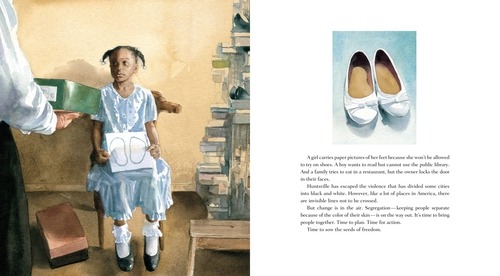
When I wrote the book, I assumed I’d live in Huntsville when it was published; however, two years ago, my family moved to Santa Fe, New Mexico – a crossroads of Native, Hispanic, and Anglo culture for hundreds of years.
During visits to some of the nineteen pueblos in the state, I’ve been appalled to learn about atrocities committed against native peoples by the Spanish and by Americans. I asked one Native American tour guide how he could relate such devastating past events to audiences – whose ethnicity was similar to those who had been so cruel to his people – without any trace of bitterness. He smiled and replied calmly: you and I did not do these terrible things, he said, and a grudge only harms the person who holds it. When I expressed my sorrow and regret anyway, he smiled again and said that apology is not required, only learning from the past to create a better future.
This tour guide’s choice to reject ethnic hatred reminded me of why I had been so determined to publish this story. I had heard the same lack of resentment in the voice of Dr. Sonnie W. Hereford III, as he related the events of January 1962 to September 1963 that are the basis for the book.
Dr. Hereford had been denied basic human rights in his hometown and, as a professional man, could have relocated his family to a less segregated city. But Dr. Hereford and his wife chose to remain and lead peaceful protests in order to make a positive difference for their children and everybody else, as did others who could have left town without taking such risks.
The responses of these two men – a Native American tour guide in New Mexico and an African-American medical doctor in Alabama – whose experiences were so different from mine, made me feel embraced by the “other,” even more resolved to celebrate this true story, when the black and white people of Huntsville chose peace over violence.
The civil rights era is but one of the many episodes of differences between groups of people that have led to violent times in America. The message I hope Seeds of Freedom carries forward is that, while problems accepting diversity in the world persist, solving them through peaceful means is not only preferable but possible. Each of us is faced with choices every day, and we can all choose peace.

Hester Bass is the author of the picture book biography The Secret World of Walter Anderson, illustrated by E.B. Lewis, which won an Orbis Pictus Award for Outstanding Nonfiction for Children, as well as the picture book So Many Houses, illustrated by Alik Arzoumanian. Formerly residing in Huntsville, Alabama, she now lives in Santa Fe, New Mexico.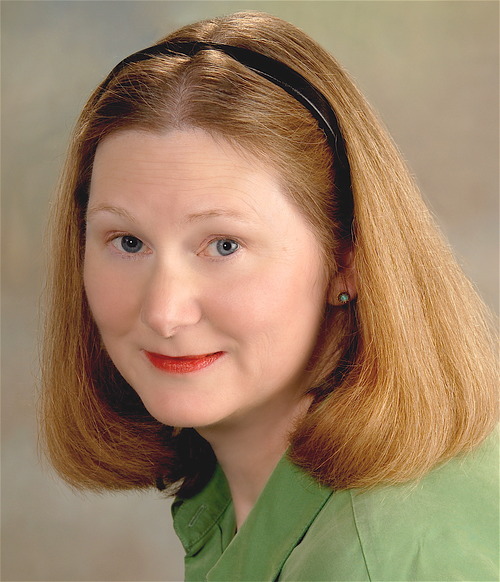
-

2014 Multicultural Literature Statistics from the Cooperative Children’s Book Center
For a look at the CCBC’s research methods and previous annual reports, click here. About the CCBC The Cooperative Children’s Book Center (CCBC) is a unique examination, study, and research …
-

Lucy Cousins on Maisy’s World
For me, she is just Maisy, in Maisy’s world, and it’s completely separate from our world. When I did the very first drawing of Maisy about twenty-five years ago, I …
-

Apply for the 27th Annual Ezra Jack Keats Mini-Grant Program
Deborah Pope, Executive Director of the Ezra Jack Keats Foundation says: Teachers and librarians across the country are creating exceptional Mini-Grant programs that are not only inventive and tailored to …
-

Becca Fitzpatrick to Write a New Romantic Suspense YA Novel
Dangerous Lies is a romantic suspense novel, and I think the new title strongly alludes to a threat of danger and a promise of love. I can’t wait to introduce …
-

How to Encourage Kids to Read
When you spot your kid huddled over a book, you can snap a photo and share it online with the hashtag #CatchThemReading. The weekly family discussion…takes reading out of the …
-

John Green Praises Booksellers
Recalling his first author tour 10 years ago for his debut novel, Looking for Alaska, John Green insisted that everything he learned about the publishing industry he learned from independent …
