
Blog
-

The New York Public Library Challenges Kids and Parents To Read 20 Minutes A Day This Summer
New York, NY – In an effort to combat “summer slide” and keep kids and teens thinking over break, The New York Public Library has issued a challenge to all …
-

A House Built By Many
Contributed by Alyssa Mito Pusey, Senior Editor, Charlesbridge
“Every single day,” Michelle Obama told the graduating class at the City College in New York, “I wake up in a house that was built by slaves.”
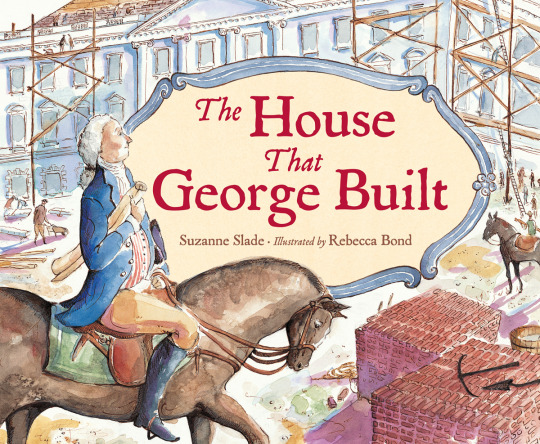
She’s right; the White House was built in large part by slaves, along with freed black men and immigrants from Scotland and Ireland. So why did I edit a book called The House That George Built? As Allie Jane Bruce points out in a recent blog post on Reading While White, the book privileges white perspective and glosses over the contributions of slaves.

When I first read Allie’s review, my stomach sank. I was horrified. Of course she was right. Why hadn’t I seen it before?
The House That George Built is a play on the old rhyme “The House That Jack Built.” At the time, it seemed like a clever and appropriate twist for a book about how George Washington conceived of a President’s House and then oversaw its construction. I set about editing the text with two primary goals: (1) to keep the text tightly focused on George and (2) to explain the building process as clearly as possible. As a nonfiction editor, I’ve always been concerned with structure, focus, and technical accuracy in picture books.
Unfortunately, I wasn’t as aware of issues of inclusion and representation. The focus on George meant that the contributions of the people who literally built the White House were minimized. The focus on the what of construction meant that the who ended up as short mentions in the main text and author’s note. Looking back, the author and I regret these decisions.
I edited The House That George Built back in 2009. Fast-forward to 2016. The publishing climate has dramatically changed—for the better in terms of awareness of diversity issues.
For me, it’s a nerve-racking time, in some ways. Authors and editors are being held to more rigorous standards, and I really don’t want to mess up. I certainly don’t want to incur the wrath of the blogosphere. More importantly, I don’t want to produce books that perpetuate racial stereotypes and white privilege, however unintentionally.
My fears aside, this is also an exciting and empowering time. I feel like my eyes are being opened, like I’m learning and growing with every article and blog post—Allie’s included. I’m receiving and acquiring more biographies of people of color. I’m asking experts and other readers for honest feedback on questions of representation. And I’m trying with every book to be as inclusive as possible.
I’ve got a long way to go, clearly. But I hope to keep on improving as an editor—and to do what I can to help publish nonfiction that accurately reflects our diverse world.

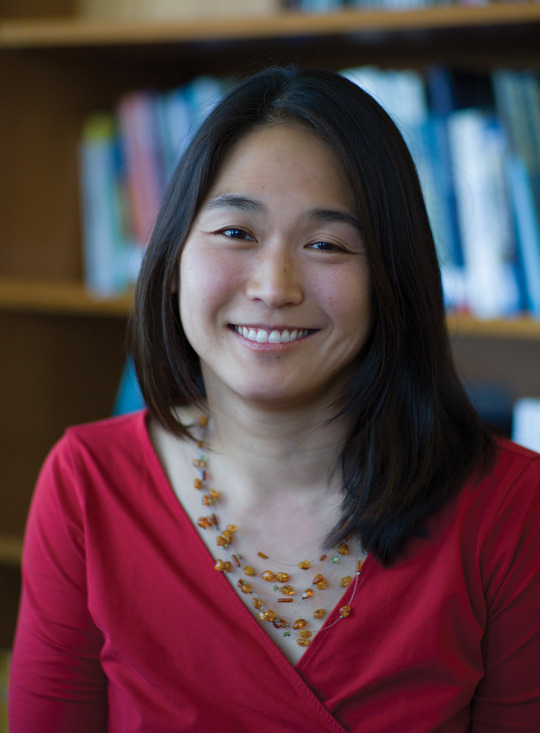
Alyssa Mito Pusey is a senior editor at Charlesbridge, editing picture books and middle-grade chapter books and specializing in nonfiction.
-

National Ambassador Gene Luen Yang’s Reading Without Walls Podcast: Episode 4 with Hope Larson
Through his platform, “Reading Without Walls,” Yang hopes to inspire readers of all ages to pick up a book outside their comfort zone. In episode four of his podcast, Yang talks …
-

#DrawingDiversity: ‘Ada’s Violin’ by Susan Hood, illustrated by Sally Wern Comport
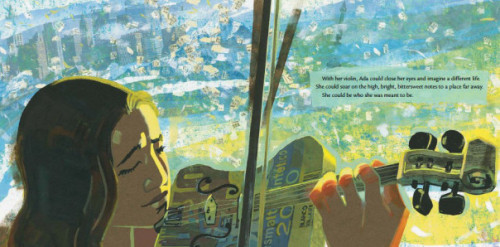
Ada’s Violin: The Story of the Recycled Orchestra of Paraguay by Susan Hood, illustrated by Sally Wern Comport (Simon & Schuster Books for Young Readers, May 2016). All rights reserved. @simonandschusterbooks
-

YALSA Announces its Teens Succeed With Libraries Video Contest Winners
CHICAGO, IL — The Young Adult Library Services Association (YALSA) has announced the winners of its Teens Succeed with Libraries video contest. The contest was open to library staff and the …
-

Scholastic to Launch ‘Horizon,’ a new Multiplatform Series Led By #1 New York Times Bestselling Author Scott Westerfeld
NEW YORK, NY (June 10, 2016)— Scholastic, the global children’s publishing, education, and media company, and the pioneering force behind the groundbreaking and bestselling multi-platform properties The 39 Clues® and …
-

The Reading Experience of Kids and Adults
For Prose, the immersive reading experience of childhood is difficult to recapture as a mature reader, but still possible. Moser prefers to revisit favorite reads, allowing himself to turn off his …
-

National 2016 Scholastic Art & Writing Awards Recipients to be Celebrated at Carnegie Hall
NEW YORK, NY — More than 660 creative teens from across the country will gather at Carnegie Hall in New York City tomorrow evening to be recognized as national recipients …
-

YA Roundtable
Though they write in different genres, the four authors are united by an enduring connection to the joys and struggles of young people, which makes their writing ring true. From the recent …
-

Reading the Cultural Revolution
Contributed by Faye Bi, Senior Publicist, Simon & Schuster Children’s Publishing
This year marks the 50th anniversary of the Cultural Revolution in China, which historians agree took place 1966-1976. Many Western media outlets were quick to provide retrospectives (see: The New York Times, The New Yorker, The Guardian, CNN, and The Atlantic), but up until recently, it represented a huge gap in my historical knowledge, despite being born to two Chinese immigrant parents. This colossal historical event that caused nearly 2-30 million deaths (depending on whom you ask) was barely touched on in my formal education; China was nowhere near its current economic prowess when I was a kid, not important enough to be put under the international spotlight until now.
My parents, who arrived in Canada in 1989 with an infant-me in tow, were tight-lipped about their life in China beforehand. They were born in 1960, young children who came of age during the Cultural Revolution under conditions of which I was blissfully unaware. There were clues, of course—we lived a frugal life on my father’s Ph.D. stipend, and I was taught from an early age not to waste food. Education was highly prized, and my wardrobe was a steady rotation of homemade clothes, knits, and hand-me-downs. And then there were offhand comments, like, “I would have had to work in the countryside if I hadn’t moved to Canada” from my father, or “My parents sent me away as a baby to live with my grandmother” from my mother. I knew my mother had worked in a shoe factory, on her feet for 12 hours a day, which meant our early weekends selling spring rolls at the flea market for extra cash were pittance.

I suspect my story is not uncommon amongst Chinese immigrants of this time. As I got older, I found it difficult to ask questions, especially if the memories were painful. My attempts were casually brushed aside, with a “there’s a reason we moved—to make a better life for you.” It wasn’t long before I did what I usually do when I’m stuck: turned to a book.
Ying Chang Compestine’s Revolution Is Not a Dinner Party had been on my radar for a few years. I was wary of adult non-fiction or even adult fiction, given my personal relationship with the subject matter, but Compestine’s slim tome was perfect—inspired by her own life growing up in Wuhan, where my mother has relatives. The book begins with nine-year-old Ling, the daughter of two doctors in the best hospital in Wuhan. She lives a comfortably middle class life, with new dresses in pretty fabrics and occasional treats of chocolate. Her upstairs neighbors have a sewing machine and a water heater. She complains when her mother makes food she doesn’t like; loves learning English from her father and listening to Voice of America; and lives the life of a young girl we wouldn’t find so unfamiliar to our own.
Then Comrade Li shows up and Ling’s father’s office is cleared out to be transformed into a bedroom for him. Comrade Li’s portrayal is a nuanced one; Compestine certainly depicts him as a villain, but tender conversations between him and Ling include exchanges of origami and eggs, later transforming into Comrade Li basically taking all of the family’s food. Ling begins to hate school when fellow students form a unit of the Red Guards and viciously bully her for her love of dresses and her middle class background, calling her a “bourgeois sympathizer.” The tragedies become more and more frequent: when Ling and her father rescue an intellectual from committing suicide in the river; when Ling and her mother watch Red Guards beat a midwife’s family; when their neighbor, Niu, denounces his family and Ling’s, drawing a class line; and when Ling’s own father is taken away and jailed.
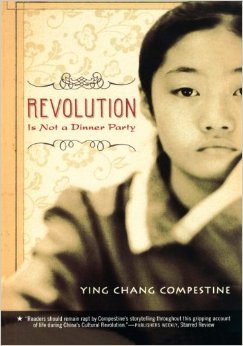
Compestine does touch on the political events of the time, but she focuses the story on Ling. In a sense, I’m not as interested in what Chairman Mao did or what his motivations were, but how so many lives were irrevocably, irreparably changed. Descriptions of waiting in line with ration tickets hoping for meat; Niu being sent to reeducation camp in the country and trying to escape; Red Guards and comrades trashing Ling’s home;, or just not having enough food. Aside from the violent political struggles by the Red Guards against dissenters, the utmost killer of the Revolution was famine.
It was a difficult read for me, with heartache and occasional tears, imagining my parents growing up during this time period. Given that the Red Guards were primarily made up of students, Revolution Is Not a Dinner Party’s perspective is rich and harrowing, right at the center of the action. Though I’m sure it doesn’t fully cover its vast scope, I was able to tell my father I’d read a book about the Cultural Revolution. He wanted to talk about the political effects; I wanted to talk about people. It was rough getting him to open up, but he did tell me that he was one of the lucky ones—schools and universities had re-opened by the time he was getting his education. His siblings (my aunts and uncles who were 8-12 years older than him) didn’t have those opportunities. “It set back an entire generation,” he says. “I remember attending school sitting next to students twice my age.”
Revolution Is Not a Dinner Party has an uplifting ending, though hints at the troubles to come. After Chairman Mao’s death, the political tides turn and Comrade Li is arrested. Ling’s father is released from prison, and her family is reunited. My family has a happy ending as well—and I appreciate every opportunity to learn those stories. I have books to thank for starting the conversation.
Further Reading
Chun Yu, Little Green: Growing Up During the Chinese Cultural Revolution
li Jiang, Red Scarf Girl
Moying Li, Snow Falling in Spring
Ying Chang Compestine, Revolution is Not a Dinner Party

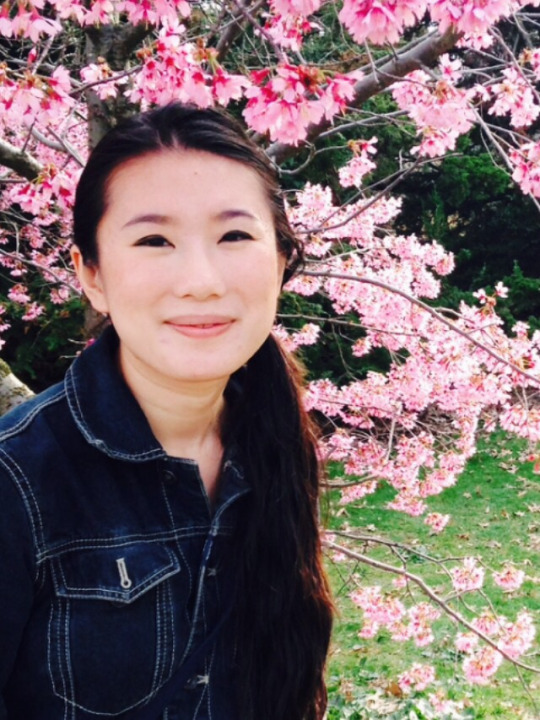
Faye Bi works as a Senior Publicist at Simon & Schuster Children’s Publishing and Saga Press, and also volunteers for Sirens, a conference dedicated to women in fantasy literature. She tweets at @faye_bi.
-

YALSA Announces its 2016 Top Ten Summer Learning Programs
CHICAGO, IL — The Young Adult Library Services Association (YALSA) has announced its list of 2016 Top Ten Summer Learning Programs from its Teen Programming HQ contest. The top ten …
-

The CBC Partners with the unPrison Project for Second-Consecutive Year to Build Prison-Nursery Libraries for Incarcerated Mothers and Their Babies
BRAND-NEW LIBRARIES CREATED IN 20 STATES New York, NY – June 8, 2016 – The Children’s Book Council (CBC) has partnered once again with The unPrison Project — a 501(c)3 …
-

2016 Lambda Literary Award Winners Announced
The 2016 Lambda Literary Award winner in the LGBT Children’s/Young Adult category is: George by Alex Gino, Scholastic Press 2016 Finalists: About a Girl: A Novel, Sarah McCarry, St. Martin’s Griffin Anything …
-

#DrawingDiversity: ‘More-igami’ by Dori Kleber, illustrated by G. Brian Karas
More-igami by Dori Kleber, illustrated by G. Brian Karas (Candlewick Press, May 2016). All rights reserved.
-

2016 Ned Vizzini Teen Literary Prize Announced
The first-ever prize was presented on June 7 at the Brooklyn Public Library. The poetry winners were Kat Snoddy, Odelia Fried, and Lucy Berry. The prose winners were Stina Trollbäck, Adil Gondal, and …
-

Reading Is Fundamental Implements Summer Reading Grant Initiative
WASHINGTON, D.C. — Reading Is Fundamental (RIF), the nation’s largest children’s literacy organization, announced the recipients of a Read for Success grant to promote summer reading, and help improve reading proficiency …
-

Ezra Jack Keats “100th Birthday Blowout Weekend” In June Planned In Brooklyn To Celebrate Centenary Of Late Author-Illustrator
NEW YORK, June 2, 2016 — In honor of the late children’s author-illustrator Ezra Jack Keats’centenary, the Ezra Jack Keats Foundation is planning an “Ezra Jack Keats’ 100th Birthday Blowout Weekend,” …
-

YA Authors Share Advice for Their Teenage Selves
Nicola Yoon (Everything, Everything) wishes she’d known as an adolescent that “the answers don’t matter as much as the asking“; Rosalind Jana (Notes on Being Teenage) proclaims that “you are enough as …
-

11 Leading Educators Announced as Next Group of Heinemann Fellows
BOSTON, MA – Heinemann, a division of Houghton Mifflin Harcourt, today announced the 2016 class of Heinemann Fellows, a select group of accomplished educators who share the goal of advancing the …
-

#DrawingDiversity: ‘A Stick is an Excellent Thing’ illus. by LeUyen Pham
A Stick is an Excellent Thing: Poems Celebrating Outdoor Play by Marilyn Singer, illustrated by LeUyen Pham (Clarion Books/HMH, February 2012). All rights reserved.
