
Blog
-

Candlewick Teams up with Italian Publisher minibombo
[Senior executive editor at Candlewick] Sarah Ketchersid added in the release that minibombo’s ‘inclusive, intelligent picture book making for little ones’ is simple in design with few or no words …
-

Lauren Oliver on J.K. Rowling’s Influence
Now a children’s and young adult author in her own right, Oliver continues to reread the Harry Potter books, each time renewing her connection to Rowling’s magical world: Last fall, …
-

Remembering Illustrator Margaret Bloy Graham
Graham was born and raised in Toronto, where she developed an artistic passion at a young age, studying at Toronto’s Art Gallery and later the University of Toronto. She moved to New …
-

Multicultural Children’s Book Day 2015
Explore the official website for Multicultural Children’s Book Day to:
- Learn about amazing, diverse authors and illustrators
- Read multicultural children’s book reviews
- Participate in a virtual book drive
- Talk about diversity in children’s literature during the #ReadYourWorld Twitter chat
- And so much more!
-

Natalie Babbit’s ‘Tuck Everlasting’ Turns 40
To this day, Babbit feels that she created the book as she intended. If given the chance to go back and re-write the novel, she would not alter the painful ending: …
-

2015 Sydney Taylor Book Award Results Announced
YOUNGER READERS Winner My Grandfather’s Coat by Jim Aylesworth with illustrations by Barbara McClintock (Scholastic Press) Honors Goldie Takes a Stand by Barbara Krasner with illustrations by Kelsey Garrity-Riley (Kar-Ben …
-

Gene Luen Yang to Write an Educational Graphic Novel For Kids
“Comics are such a powerful educational tool. Simply put, there are certain kinds of information that are best communicated through sequential visuals. Look at airline emergency cards or the instructions …
-

We Need Diverse Books Announces Short Story Contest
Phoebe Yeh, VP/Publisher of Crown Books for Young Readers/Random House, has acquired publication rights to the collection, which will be edited by WNDB President Ellen Oh for release in January …
-

2015 Edgar Award Young Adult Nominees Announced
The 2015 Edgar Award Nominees in the Young Adult Category The Doubt Factory by Paolo Bacigalupi (Little, Brown Books for Young Readers) Nearly Gone by Elle Cosimano (Penguin Young Readers …
-

New Edition of ‘Will Grayson, Will Grayson’ to Feature New Cover
“Five years ago, the book about two friends with the same name debuted at #3 on the New York Times children’s chapter book bestseller list. To celebrate the anniversary, the …
-

Egmont USA to Close Operations
Established in 2008, Egmont USA specialized in children’s books in the elementary, middle grade, and young adult genres. The company’s final list will be distributed by Random House in spring 2015. Rob McMenemy, CEO of …
-

The Eric Carle Museum Welcomes New Chief Curator
Amherst, MA—Ellen Keiter has joined The Eric Carle Museum of Picture Book Art as the new chief curator, replacing H. Nichols B. Clark, the Museum’s founding director and chief curator. …
-

SCBWI’s 2014 On-The-Verge Emerging Voices Award Winners
The prize, which includes an all-expense paid trip to the SCBWI Summer Conference in Los Angeles and and one-on-one meetings with industry professionals, is a part of SCBWI’s mission to bring traditionally …
-

CBC Diversity: ‘It’s Possible’ Series Honors Walter Dean Myers
In a poignant letter addressed to the late author and National Ambassador for Young People’s Literature, Andrea Davis Pinkney — VP and Executive Editor of Trade at Scholastic — introduces …
-

Two Producers Option ‘This Song Will Save Your Life’
“Tony-winner Kevin McCollum (Avenue Q, Rent) and TV producer Michael Novick (best known for Glee) announced the deal today for the 2013 young adult novel, about a misfit teenage girl …
-

Kate DiCamillo Named National Summer Reading Champion
Washington—The Collaborative Summer Library Program (CSLP) has announced its partnership with award-winning children’s book author and National Ambassador for Young People’s Literature, Kate DiCamillo, as its first ever National Summer …
-

CBC Diversity: Inclusion vs. Diversity
Contributed to CBC Diversity by Tonya Cherie Hegamin
Human brains like to compartmentalize, and I believe that the term “diversity” serves to place people in boxes marked “other”. However, as individuals, the cultural, physical and learning differences we have must harmonize for survival. I expect to be addressed as a whole human, not one whose life circumstances make me ‘different’. Truly, “diversity” in its best light seeks to celebrate our differences, to acknowledge those on the margins of “normal”, but it does not necessarily seek to include all of us as we are. Would you choose to just be tolerated or to be wholly accepted as you are?
Personally, I consider myself to be beautifully complicated. On the surface, many people might think I’m Latina or biracial because of my skin color and hair. In reality I am multi-racial, just like so many other people. Once when I was five, a neighbor (who was white) asked me “What are you?” I didn’t understand—I asked my mother and she told me to say I was “black”. When I went back to my playmate, she informed me that I couldn’t be black because I didn’t look, act or sound black, and if I was black her parents would refuse to let her play with me. That’s a lot for a five year old to handle. Not just for me, but for this girl who was subjected to a binary world where some people were “acceptable” while others were not.
For me, it was only the first of a countless number of times people demanded to know what I was. I come from a long line of ‘light skinned’ African-Americans (both my paternal grandfather and great grandfather passed for white to get jobs) who mingled with Nanticoke Indians (my maternal grandfather could trace his family to the last ‘royalty’ of the tribe), also Dutch, Haitian, Scottish and probably a hundred other combinations. Both sides of my family still hold emancipation papers from ancestors who begat the children of their masters. Internalized racism, color-isms and social/class structures probably supported my family marrying those whose experience was similar; yet we still identify as black or African-American. At this point, I’ll remind us all that “race” is a social construct created to specifically compartmentalize dark skinned people as inferior and white Europeans as superior. However, we are still hooked on creating separate compartments for people, and I believe the claim of ‘diversity’ supports that line of thinking.
But my beautifully complicated world does not hinge on race or culture alone. I also have dyscalculia (a learning disorder) and a chronic immunodeficiency disease which requires multiple daily injections and also causes chronic pain, fatigue and depression. Therefore I’m in the “disabled” compartment too. I am also bisexual, yet another compartment. Do I live in a compartmentalized body, mind and soul? Of course not. I have learned to integrate and include all of that “diversity” as a part of my singular human experience. At five, I just wanted that playmate to include me in the fun. Growing up I became severely depressed trying to prune myself to fit into one group or another; now I realize it never works, I accept myself as I am.
Teaching in a predominantly black college in Brooklyn, NY also made me realize the value of inclusivity over diversity. In my Children’s and Young Adult Literature classes, we critically examine inclusive literature and how it allows readers access to a variety of world views and perceptions. I’ve learned another hard lesson in those classrooms—I realized that I suffer from ‘perceived commonality’. I thought that because my students were also black, we shared a communal memory of racism in America. I now know that many of my students would never identify themselves as black, much less American. They are all just as beautifully complicated as me!
I stress to my future teachers to teach the individual as they are, to include a variety of perspectives. As a writer, I strive for that, too, but I also try hard to make every character as “real” as possible; for me, that means including all the contradictions and complexities that in the end, makes them beautiful.


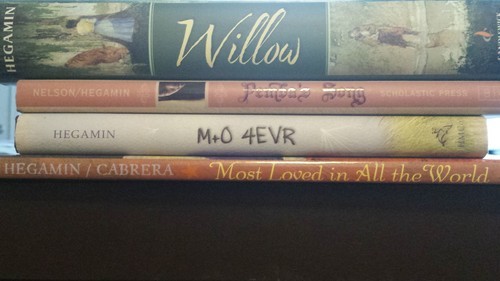
Tonya Cherie Hegamin is the author of the young adult novel Willow, M+O 4EVR and the coauthor with Marilyn Nelson of Pemba’s Song. She received an Ezra Jack Keats New Writer Award and a Christopher Award for her picture book Most Loved in All the World, illustrated by Cozbi Cabrera. She is the creative writing coordinator at Medgar Evers College in Brooklyn. Learn more about Tonya by visiting her website: www.tonyacheriehegamin.com.
-

Holly Black Reveals The Influences Behind ‘The Darkest Part of the Forest’
“There are a few bits of folklore I drew on specifically for The Darkest Part of the Forest. I started with the idea that I was going to rewrite a …
-

‘It’s Possible’ Series: A Place in History
An “It’s Possible” post contributed to CBC Diversity by Jennifer M. Brown
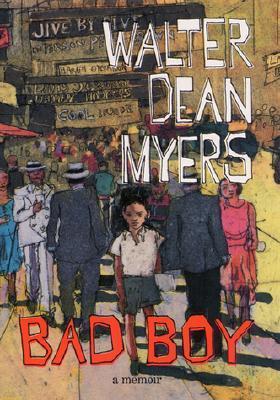
"Each of us is born with a history already in place." Those words open Walter Dean Myers’s memoir, Bad Boy. The word “history” applies to that of the individual child, born into a family and a set of circumstances. “History” is also tied to a physical place. Walter Dean Myers was profoundly aware of both.
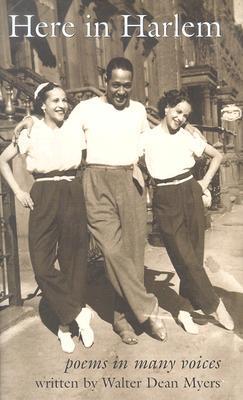
He believed that individuals could change history; he watched them do it, and he was an instrument of change himself. He also had deep ties to his childhood home in Harlem. From his picture book Harlem, illustrated by his son Christopher Myers, to his Newbery Honor book Scorpions and the inaugural Printz winner, Monster, he wrote of Harlem’s glories and its sorrows. If you were lucky enough to hear him tell stories of his youth, he’d describe walking down the street and stopping to talk with Langston Hughes, and attending dances and sermons at “a shouting church,” immortalized in one of the poems in Walter’s collection Here in Harlem.
I was 21 and assistant to Bill Morris, director of library promotion at Harper & Row, when Bill introduced me to Walter. They made a comical pair. Bill, the Southern gentleman at 5’2”, and Walter, a full foot (and then some) taller and a straight-shooter New Yorker. But they were great friends, and had the utmost respect for each other. From this vantage point, I got to hear Walter speak at numerous conferences. Wherever Walter went, he commanded a room, standing head and shoulders above most of the people in it. It wasn’t always what he said that made you tilt forward, trying to eavesdrop. It was the way he listened, followed by the concise response that conveyed how closely he’d listened, sometimes responding to what you hadn’t said.
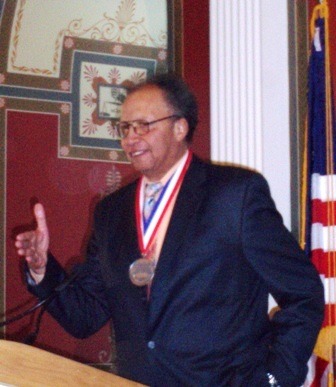
A year ago, when Walter Dean Myers, as National Ambassador for Young People’s Literature, passed the torch to his successor, Kate DiCamillo, he described what he called the most important moment in his two years as Ambassador: “I was in a prison that was loosely run. By that I mean, some talking is allowed among the inmates,” Walter said. When he started to speak, an inmate was talking. “‘Keep quiet, I want to hear this,’ one inmate said to the other,” Walter recalled. “That touched me. I knew this program was working.”
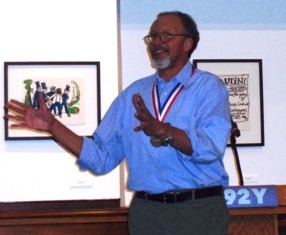
When Walter spoke at the 92nd Street Y, a year into his ambassadorship, he described a conversation he’d had with Langston Hughes when Walter was in his 20s. Hughes had been criticized for writing for “the lowest element of black life,” as Walter put it. Hughes told Walter, “That’s who I want to write for.” In his book Just Write: Here’s How! Walter wrote, “Reading probably saved my life.” For him, reading was not an option, it was essential. He transformed his personal credo into his platform as ambassador: “Reading is not optional.” He also says, in Just Write, “I write books for the troubled boy I once was, and for the boy who lives within me still.” He worried about the kids who begin school behind, and how only 15% of them ever catch up.
He worried about them because he’d been where they were and he’d walked in their shoes. He also wanted to give them hope—if this “bad boy” could turn his life around, so could they. He knew, too, that his stories could appeal to people who had not walked in their shoes. If Walter, as a teenager, could relate to Stephen Daedalus in James Joyce’s A Portrait of the Artist as a Young Man, then books could unite all races and cultures. Books could save the lives of young people everywhere, in myriad ways.
Even after he’d won the inaugural Printz Award, multiple Coretta Scott King Awards and Honors, Newbery Honors, the Virginia Hamilton Award, the Margaret Edwards Award and been named a National Book Award finalist numerous times, Walter continued to challenge himself. Soon after he’d won a MacDowell Colony Fellowship, to spend some uninterrupted time writing in a cabin in New Hampshire, he told me his goal while there was to “slow down.” He wanted to write fewer pages a day. But I don’t think he ever could. He had too much to say.
It’s hard for me to believe that Walter Dean Myers no longer walks the earth. His sense of humor, his world view, his wisdom, remain with me. Hardly a day goes by when I don’t think, What would Walter say about this? What would he notice that I’m missing? How can I pay more attention to what matters? The closing lines of Bad Boy uplift me: “Writing had let me into a world in which I am respected, where the skills I have are respected for themselves…. All in all it has been a great journey and not at all shabby for a bad boy.”

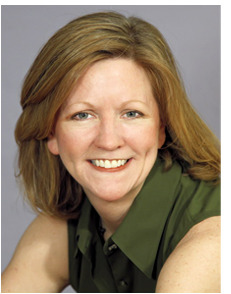
Jennifer M. Brown has been in children’s books for more than 25 years. She writes for School Library Journal, Kirkus Reviews, and is children’s editor of Shelf Awareness. She is also the director of the Center for Children’s Literature at the Bank Street College of Education.
-

When It Comes to Books, Allow Kids to Enjoy Freedom of Choice
“For decades, researchers have been suggesting that a little structured fun with books can help kids learn to appreciate them, and that kids who like to read tend to become …
